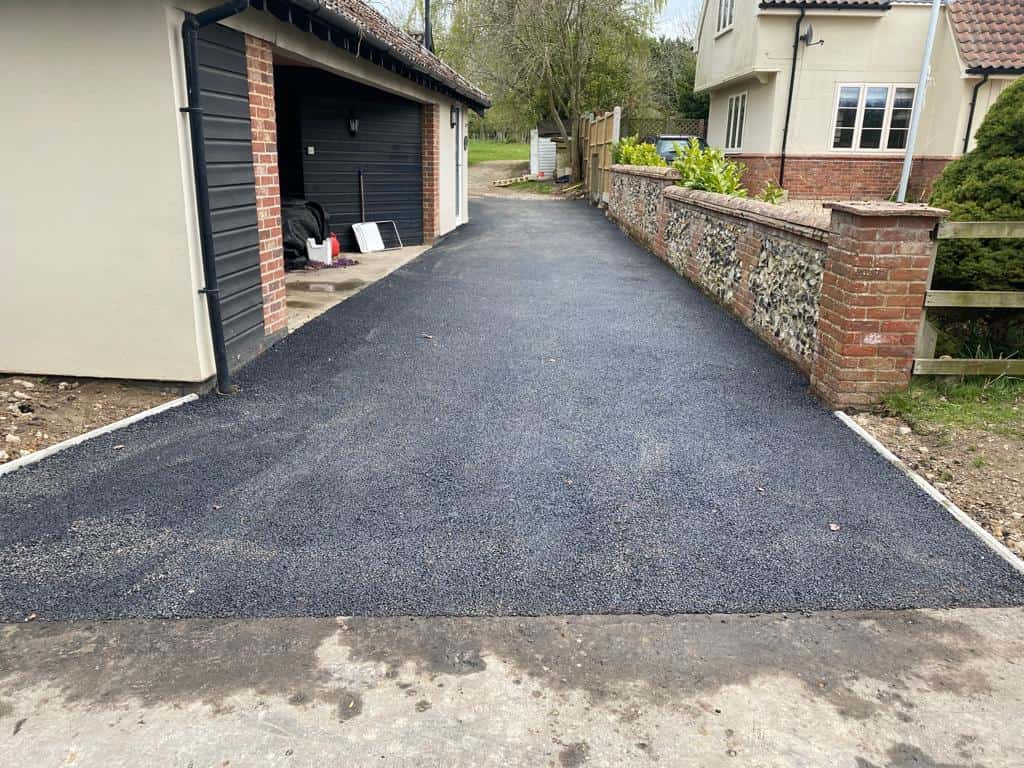
What Makes Tarmac Suitable for Agricultural Roads and Farm Access Routes?
Agricultural roads and farm access routes have a demanding role. Unlike a typical residential driveway, these surfaces may need to accommodate regular vehicle movements, machinery, deliveries and changing patterns of use throughout the year. They also need to provide dependable access when ground conditions around them are wet, muddy or heavily trafficked.
For agricultural properties in Dorking, Surrey, tarmac can provide a practical surfacing option where a firm, continuous and well-prepared access route is required. Its suitability comes not simply from the visible surface, but from the complete construction beneath it. Ground preparation, sub-base strength, compaction, drainage, levels and edge support all influence how successfully a tarmac road performs.
A well-planned agricultural access route should therefore be designed around how the surface will actually be used. Vehicle types, turning movements, entrances, gradients and areas where traffic repeatedly concentrates should all be considered before construction begins.
Why Can Tarmac Work Well for Agricultural Roads and Farm Access?
Tarmac is well suited to many agricultural access routes because it creates a firm, continuous surface capable of supporting regular vehicle movements when constructed over an appropriate foundation.
Compared with an unbound or deteriorated access track, a properly constructed tarmac surface can provide more consistent driving conditions and reduce many of the problems associated with loose material, ruts, muddy sections and irregular ground.
However, the surface itself cannot compensate for weak foundations. Long-term performance depends heavily on what happens before the tarmac is laid.
Agricultural Access Routes Need a Strong Foundation
The foundation beneath an agricultural road is fundamental to its performance.
Vehicles transfer loads through the tarmac into the construction underneath. If the supporting layers are unstable, poorly compacted or unsuitable for the intended traffic, movement can eventually become visible at the surface.
This is why preparation should be considered part of the tarmac installation rather than simply a preliminary stage.
Ground Conditions Should Be Assessed First
Not every agricultural access route begins with the same conditions.
One route may already have a relatively firm base, while another may cross weak or uneven ground.
Before surfacing, the existing area should be assessed to determine what preparation is necessary.
Simply laying tarmac over an unsuitable track may hide existing problems temporarily without resolving the underlying cause.
The Sub-Base Helps Distribute Vehicle Loads
A correctly prepared sub-base creates a stable platform beneath the finished tarmac.
Its purpose is to support and distribute the loads passing over the road.
This becomes particularly important where the access route is expected to accommodate agricultural vehicles or regular commercial traffic.
A strong finished surface begins with a foundation appropriate for the anticipated use.
Compaction Is Essential
Placing suitable material beneath a road is only part of the preparation.
It also needs to be compacted correctly.
Insufficient compaction can allow sections of the construction to settle under repeated traffic, potentially creating depressions and uneven areas.
Careful preparation and compaction help create a more consistent foundation before the surfacing layers are installed.
Tarmac Creates a Continuous Driving Surface
One of the practical advantages of tarmac is its relatively continuous finish.
Agricultural access routes can become uncomfortable and difficult to use when the surface contains repeated holes, loose material or pronounced irregularities.
A properly installed tarmac road creates a more consistent route for vehicles travelling between entrances, buildings and working areas.
This can make everyday access more straightforward.
A Firm Surface Can Reduce Rut Formation Associated With Loose Tracks
Unbound access routes can gradually develop wheel tracks where vehicles repeatedly follow the same path.
As depressions deepen, water may collect within them and the route can become increasingly uneven.
A properly constructed tarmac surface provides a bound finish rather than relying on loose surface material.
The foundation still needs sufficient strength because tarmac laid over an unstable base can itself deform.
Tarmac Avoids the Movement of Loose Surface Aggregate
Loose stone can migrate under repeated vehicle movement.
Turning, braking and acceleration can push material away from heavily trafficked sections, creating uneven distribution.
Tarmac provides a bound surface, so the finishing material does not move around in the same way.
This can be particularly useful around entrances and regularly travelled sections where loose material would otherwise require repeated redistribution.
Agricultural Vehicles Can Create Concentrated Loads
Agricultural traffic is not always comparable with ordinary cars.
Vehicle weight, axle loading, tyre configuration and frequency of use can all influence the demands placed on an access route.
The surface specification should therefore reflect the intended traffic.
A road expected to carry heavier vehicles needs a construction suitable for that purpose rather than simply being treated as an enlarged domestic driveway.
Turning Areas Require Particular Attention
Vehicles do not place identical demands on every part of an agricultural road.
Straight-line travel generally creates different forces from tight turning movements.
At entrances, junctions and turning areas, tyres can place greater stresses on the surface.
These sections should be considered during design and construction so that the foundation, edges and finished surface are appropriate for the expected movements.
Entrances Can Experience Repeated Traffic Concentration
The entrance to an agricultural access road often receives every vehicle using the route.
This concentrates movement within a relatively small area.
Vehicles may also brake, accelerate or turn as they enter and leave.
Good preparation around the entrance is therefore particularly important.
The road should be designed as a complete working route rather than concentrating only on the long straight sections.
Passing and Manoeuvring Areas Need Suitable Construction
Where vehicles regularly manoeuvre or pass one another, traffic may spread beyond the main wheel paths.
These wider sections need the same consideration as the rest of the road.
If an area is likely to be used frequently, it should be included within the planned construction rather than treated as an occasional extension of the main route.
Understanding vehicle movements before installation helps establish appropriate dimensions.
A Smooth Route Can Improve Everyday Access
Agricultural roads are working surfaces.
Drivers may use them repeatedly throughout the day, and uneven routes can make routine movements unnecessarily difficult.
A consistent tarmac finish can provide a more predictable driving surface.
This can be particularly useful where access needs to remain practical for different types of vehicle rather than serving only one specific use.
Surface Levels Are Important
A road should not simply be flat without consideration of where water will go.
Levels need to be established so that rainfall can move appropriately rather than collecting unnecessarily across the surface.
Poorly planned levels can create low points where water repeatedly gathers.
These areas may become inconvenient and can indicate that the drainage arrangement needs attention.
Drainage Should Be Planned Before Surfacing
Water management is an important part of agricultural road construction.
The surrounding ground, road gradient and intended route of surface water should be considered before tarmac is installed.
Attempting to solve drainage problems only after the surface has been completed can be considerably more complicated.
Planning levels and drainage together provides a better basis for long-term performance.
Standing Water Should Not Be Treated as Normal
Occasional surface water during heavy rainfall can occur on many external surfaces, but persistent ponding deserves attention.
Repeated pools may indicate unsuitable falls, local depressions or drainage limitations.
If an existing agricultural route already suffers from standing water, simply covering it with a new surface may not solve the underlying problem.
The cause should be considered during preparation.
Water Can Affect Weak Foundations
Where water repeatedly reaches poorly constructed or unstable underlying material, the road can become more vulnerable to movement.
This reinforces why drainage and foundation design should be considered together.
A strong surface above weak, water-affected ground may eventually reflect movement from below.
Good tarmac installation therefore starts beneath the visible road.
Edge Support Is Important on Agricultural Routes
Road edges can become vulnerable where vehicles regularly travel close to the boundary of the surfaced area.
If wheels repeatedly leave and re-enter the road, the edge may experience additional stresses.
Appropriate edge construction helps support the finished surface.
The design should also provide sufficient width for the vehicles expected to use the route so that drivers are not constantly forced onto the margins.
Road Width Should Reflect Actual Use
An agricultural access road should be planned around the vehicles that need to use it.
A route that is too narrow can result in repeated driving close to edges.
It can also make turning and manoeuvring unnecessarily difficult.
Considering practical vehicle dimensions and movements during planning can help create an access road that functions properly rather than simply fitting the smallest possible space.
Tarmac Can Make Wet-Weather Access More Practical
Unsurfaced or deteriorated tracks can become increasingly difficult to use when surrounding ground is wet.
Mud, soft areas and ruts can make vehicle access inconsistent.
A properly constructed tarmac route provides a defined, bound surface that is less dependent on the condition of exposed soil.
Its performance still depends on appropriate drainage and foundation construction, but the finished route can provide more dependable everyday access.
A Defined Road Can Help Keep Traffic on a Consistent Route
Where no clear surface exists, vehicles may gradually create multiple wheel paths as drivers avoid muddy or damaged sections.
This can widen the disturbed area over time.
A properly planned tarmac access road provides a clearly defined route.
Vehicles can follow a consistent surface rather than continually seeking the firmest section of an uneven track.
Tarmac Can Connect Different Working Areas
Agricultural access may involve more than travelling from an entrance to one building.
A route can connect several working areas, storage locations or vehicle spaces.
Tarmac can be used to create continuity between these sections where a bound surface is appropriate.
Planning the complete movement pattern helps avoid creating a good main road that ends at poorly prepared transition areas.
Transitions Between Surfaces Need Attention
An agricultural road may connect with other existing surfaces.
The point where one construction meets another should be considered carefully.
Poor transitions can create abrupt level changes or weak edges.
A well-planned installation considers how the tarmac connects with surrounding access areas so that vehicles can move between surfaces smoothly.
Existing Tracks Need Proper Assessment Before Resurfacing
An established agricultural track may look like a convenient base for new tarmac, but its condition should not be assumed.
Years of vehicle movement can create compacted sections alongside weaker or previously repaired areas.
Before surfacing, the existing construction should be assessed for stability.
Weak areas may require correction so that they are not simply concealed beneath the new finish.
Existing Potholes Should Not Simply Be Covered
A pothole is usually a symptom of deterioration within the existing surface or construction.
Filling the depression and immediately laying tarmac over it may not address why it developed.
The affected area should be prepared appropriately before the new surface is installed.
Treating underlying defects provides a better foundation for the finished road.
Sunken Sections Can Indicate Base Problems
Depressions in an existing route may suggest settlement or weakness beneath the surface.
These areas should be investigated before resurfacing.
If the underlying problem remains, movement can eventually become visible through the new tarmac.
Correct preparation helps reduce the likelihood of old defects simply reappearing in the finished road.
Soft Areas Need Attention Before Tarmac Is Installed
A visibly soft or unstable section of ground should not be treated as though it is equivalent to firm surrounding material.
The affected area may require additional preparation before a stable road can be constructed.
The objective is to create consistent support beneath the surface.
Ignoring localised weaknesses can undermine otherwise good preparation across the rest of the route.
Agricultural Roads Need to Be Considered as Complete Systems
The visible tarmac is only the upper part of the construction.
A successful agricultural road combines:
- Suitable ground preparation
- An appropriate sub-base
- Effective compaction
- Correct levels
- Planned drainage
- Adequate road width
- Stable edges
- Suitable surfacing
- Well-designed entrances and transitions
- Consideration of vehicle loads and movements
These elements work together to create a practical access route.
Surface Thickness Should Reflect Intended Use
Not every tarmac installation should automatically use the same construction.
A lightly trafficked access route and an area regularly used by heavier vehicles place different demands on the surface.
The complete specification should therefore respond to intended use.
Assessing vehicle movements before installation helps determine what construction is appropriate rather than applying a standard approach to every site.
Heavy Vehicles Make Base Quality Particularly Important
It can be easy to focus on selecting a durable finishing surface when planning an agricultural road.
However, heavier traffic makes the foundation beneath it even more important.
Repeated vehicle loading can expose weaknesses that might remain unnoticed under lighter use.
The surface and supporting layers should therefore be considered together rather than treating tarmac as a standalone solution.
Tarmac Can Accommodate Long Access Routes
Agricultural access roads can extend over considerable distances.
A continuous tarmac finish can create a consistent driving surface along the route.
However, longer roads make accurate levels and preparation particularly important.
Small variations in the ground can influence drainage and surface consistency across the complete installation.
Surveying and preparing the route carefully helps establish a more uniform result.
Gradients Need Careful Planning
Some agricultural access routes include slopes.
Gradient influences vehicle movement and how rainfall travels across the surface.
The road should therefore be designed with both access and water management in mind.
A slope is not necessarily a problem, but it needs to form part of the planning process rather than being treated as an afterthought.
Tarmac Can Work for Curved Access Routes
Farm access does not always follow a straight line.
A tarmac road can be constructed around bends where the site layout requires them.
The turning radius and width should reflect the vehicles expected to use the route.
Tighter bends may need additional consideration because vehicle tyres can place greater forces on the surface during turning.
Junctions Can Become High-Stress Areas
Where one access road divides into several routes, the junction can receive considerable turning traffic.
This may concentrate loads differently from straight sections.
Good foundation preparation and appropriate surfacing are particularly important in these areas.
Planning the junction around real vehicle movements can provide a more practical layout.
Tarmac Provides a Neat, Defined Finish
Although practicality is usually the main consideration for an agricultural road, appearance can still matter.
A continuous tarmac surface creates clearly defined access through the property.
It can provide a more organised appearance than a heavily rutted or repeatedly patched track.
The visual improvement comes from consistent levels, defined edges and a continuous finish rather than decorative complexity.
A New Surface Should Not Hide Existing Drainage Problems
If an existing access route repeatedly floods or develops waterlogged sections, resurfacing alone should not be expected to correct the issue.
The route of the water needs to be understood.
Levels, surrounding ground and drainage arrangements should be considered during preparation.
Addressing these factors before laying tarmac is more effective than attempting to manage persistent water problems afterwards.
Maintenance Still Matters
Tarmac is a practical road surface, but no external surface should be considered maintenance-free.
Changes can occur over time as the route experiences traffic and weather.
Localised defects are generally worth investigating before they become more extensive.
Keeping the surface clear enough to identify changes can also make it easier to notice areas requiring attention.
Small Cracks Should Be Monitored
A small crack does not automatically mean an agricultural road is failing.
Its significance depends on where it is located, whether it changes and what has caused it.
Some defects may remain localised, while recurring or spreading cracking can indicate movement within the underlying construction.
Professional assessment can help distinguish between a surface-level issue and a problem requiring wider attention.
Potholes Should Be Addressed Before They Expand
Once a pothole develops, repeated vehicle traffic can place additional stress around its edges.
Water can also collect within the depression.
Addressing deterioration while it remains localised can help prevent the affected section from becoming increasingly uneven.
The repair should consider why the pothole developed rather than simply filling the visible hole.
Edge Deterioration Can Spread Inwards
Damage at the margins of an agricultural road can gradually affect more of the surface if vehicles continue travelling over an unsupported edge.
Early repair can help retain the usable width of the road.
Where repeated edge damage occurs, it may also be useful to consider whether the road is sufficiently wide for the traffic using it.
Correcting the cause can be more effective than repeatedly treating the same symptom.
Repeated Repairs Can Indicate an Underlying Problem
Occasional localised repairs are a normal part of maintaining many external surfaces.
However, defects that repeatedly return in the same area can indicate a deeper issue.
Weak foundations, unsuitable drainage or concentrated vehicle movements may be contributing factors.
A wider assessment can determine whether another patch repair is appropriate or whether the underlying construction needs attention.
Agricultural Tarmac Should Be Planned Around Real Vehicle Use
One of the most important stages of designing a farm access route is understanding how vehicles actually move through the site.
This can include:
- Typical vehicle types
- Frequency of movements
- Heavier vehicle access
- Entrance locations
- Turning areas
- Reversing and manoeuvring
- Junctions
- Road width
- Gradients
- Areas where vehicles regularly stop
Designing around actual use creates a more practical surface than treating every part of the road identically.
Preparation Influences the Finished Appearance
Poor ground preparation does not only affect structural performance.
It can also affect how the completed road looks.
Settlement, depressions and inconsistent levels can interrupt an otherwise uniform finish.
Careful groundwork helps produce a road that is both functional and visually consistent.
The Finished Tarmac Is Only as Reliable as Its Foundation
A high-quality surface cannot permanently compensate for unsuitable material underneath it.
This is one of the most important considerations for agricultural roads.
Where vehicle loads are significant, weaknesses beneath the road can eventually become reflected at surface level.
Investing attention in excavation, sub-base preparation, compaction, drainage and levels provides the foundation for the tarmac above.
When Might Tarmac Not Be Enough on Its Own?
Tarmac should not be treated as a way to solve every existing access problem simply by covering it.
Where the ground is unstable, drainage is unsuitable or the existing route contains significant structural weaknesses, preparatory work may be necessary before surfacing.
The correct solution therefore depends on the complete site.
Professional assessment helps establish what needs to happen beneath the tarmac as well as what finish should be installed above it.
Professional Installation Helps Match the Road to Its Purpose
Agricultural access routes can have very different requirements.
A professional installation should consider the expected traffic, ground conditions, road layout and existing drainage before construction begins.
This helps establish an appropriate specification for the particular route.
The value of professional surfacing lies not simply in laying tarmac, but in preparing and constructing the complete road around its intended use.
Tarmac Agricultural Roads and Farm Access in Dorking, Surrey
At NS Driveways Dorking, we understand that agricultural roads and farm access routes need to provide practical, dependable access rather than simply an attractive surface.
Ground preparation, sub-base construction, compaction, drainage, levels, edges and vehicle movements all need to be considered before tarmac is installed.
For agricultural properties in Dorking, Surrey, a professionally constructed tarmac access route can provide a firm, continuous surface designed around the practical requirements of the site.
Conclusion
Tarmac can be well suited to agricultural roads and farm access routes because it provides a firm, continuous and clearly defined surface for regular vehicle movements. It can improve access across routes that would otherwise be vulnerable to loose material, rutting, muddy areas and an inconsistent driving surface.
However, the tarmac itself is only one part of a successful agricultural road. Ground conditions, sub-base strength, compaction, drainage, levels, edge support, road width and the types of vehicles using the route all influence long-term performance.
The most effective approach is therefore to design the complete construction around how the access road will actually be used rather than simply laying a new surface over existing problems.
If you are considering a tarmac agricultural road or farm access route in Dorking, Surrey, contact NS Driveways Dorking. We can assess the existing ground and intended use of the route and recommend an appropriate approach to preparation and tarmac surfacing.
Call us on: 01306 772 893
Click here to find out more about NS Driveways Dorking
Click here to complete our contact form and see how we can help with your driveways needs.